

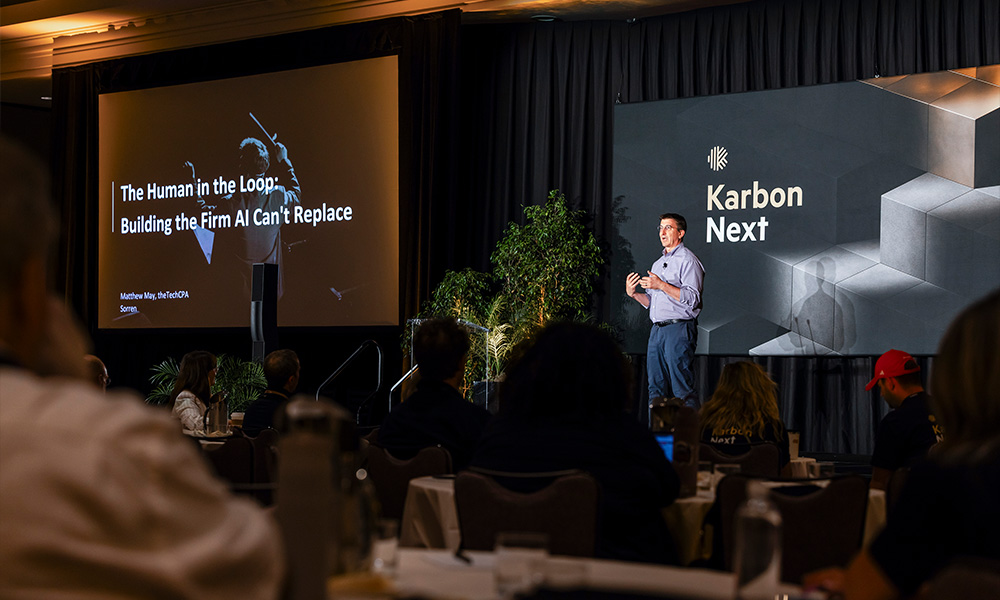
“The tractor didn’t replace farmers. It changed what made a great farmer.”
An analogy shared by Matthew May during his keynote at Karbon Next captures one of the most important shifts taking place in the accounting profession today. As artificial intelligence reshapes how work gets done, many business leaders are asking whether AI will replace accountants or fundamentally change the profession.
Those are understandable questions, but they may not be the most useful ones to ask.
A better question is this: How should technology change what businesses expect from their advisors?
Technology Changes the Work. It Doesn’t Eliminate the Need.
At the beginning of the twentieth century, nearly 40% of the U.S. workforce worked in agriculture. Success depended on physical strength, endurance, and countless hours of manual labor. Then the tractor arrived.
It didn’t eliminate farming or make farmers irrelevant. Instead, it transformed the profession. Productivity increased dramatically, but more importantly, the definition of expertise changed.
The most successful farmers became planners, operators, and managers of increasingly sophisticated systems. Their value shifted from physical labor to decision-making. Farming didn’t become less important—it became more sophisticated.
Accounting is entering a remarkably similar transition.
Artificial intelligence is becoming increasingly capable of processing information, automating repetitive work, and accelerating tasks that once required hours of manual effort. For businesses, that’s good news. Routine accounting work should become faster, more efficient, and more consistent, allowing advisors to spend less time producing information and more time helping clients turn that information into better decisions.
But efficiency alone has never been the primary reason organizations seek trusted advisors. Businesses don’t hire accounting firms simply to produce financial statements or prepare tax returns. They hire professionals who can help them interpret information, understand risk, and make better decisions.
The Greatest Value Has Always Been Judgment
Financial reports have never been the end goal. They’re tools that help leaders answer much bigger questions: Should we expand? Is now the right time to make an acquisition? Can we afford to invest in new talent? How should we prepare for a leadership transition?
Those decisions require more than data. They require context, experience, and an understanding of the business itself. They involve balancing risk and opportunity, interpreting market conditions, and aligning financial decisions with long-term objectives.
That’s where trusted advisors have always delivered the greatest value, and AI doesn’t change that. If anything, it raises the importance of those conversations. Technology can summarize information, identify patterns, and surface anomalies, but it can’t replace judgment. It can’t understand the goals, culture, or unique challenges that shape every business decision.
What Clients Should Expect From Their Advisors
For clients, this evolution should raise expectations rather than lower them. If technology reduces the time required for compliance work, it creates an opportunity for advisors to spend more time understanding the business behind the numbers.
The value of accounting isn’t diminishing. It’s evolving—from producing information to helping organizations make better decisions.
That means more proactive conversations instead of reactive ones. It means helping clients anticipate challenges before they become obstacles, connecting insights across tax, accounting, assurance, and advisory services, and translating financial information into practical guidance that supports better business decisions.
Ultimately, technology shouldn’t simply help firms deliver work faster. It should help businesses receive more insight, more foresight, and more strategic guidance.
Looking Beyond the Technology
It’s easy to focus on AI itself, but the technology isn’t really the story. The real story is how it enables advisors to spend more time doing the work clients value most: providing perspective, solving complex problems, and helping leaders make confident decisions.
The accounting profession has always evolved alongside technology. From spreadsheets to cloud accounting to AI, every advancement has changed how work gets done. What hasn’t changed is why businesses seek trusted advisors in the first place. They want someone who understands their goals, helps them navigate complexity, and gives them confidence to make important decisions.
The firms that lead the next decade won’t simply be the ones with the newest AI tools. They’ll be the firms that use those tools to strengthen relationships, provide greater clarity, and help clients make better decisions with confidence.
The tractor didn’t replace farmers. It changed what made a great farmer.
AI won’t replace trusted advisors. It will raise the standard for the advice businesses should expect.
Inspired by insights shared during Matthew May’s keynote at Karbon Next.