


What investors and project sponsors need to know before the 2026 year-end transition
The Opportunity Zone (OZ) program isn’t ending on December 31, 2026, but important changes are ahead. And for investors, fund managers and project sponsors, decisions made before year-end could have lasting tax and financial implications.
The original Opportunity Zone program (OZ 1.0) reaches a key milestone at the end of 2026, when the initial gain-deferral period closes. A new investment cycle, commonly referred to as OZ 2.0, begins January 1, 2027.
For investors, this means preparing for deferred gains to become taxable and understanding the potential impact on cash flow. For Qualified Opportunity Fund (QOF) managers and Qualified Opportunity Zone Business (QOZB) sponsors, the focus shifts to protecting existing investments, documenting project eligibility and preparing for expanded reporting requirements.
The key to navigating this transition is understanding which rules apply to your investments and taking action before critical deadlines pass.
Understanding the transition: One location, different rules
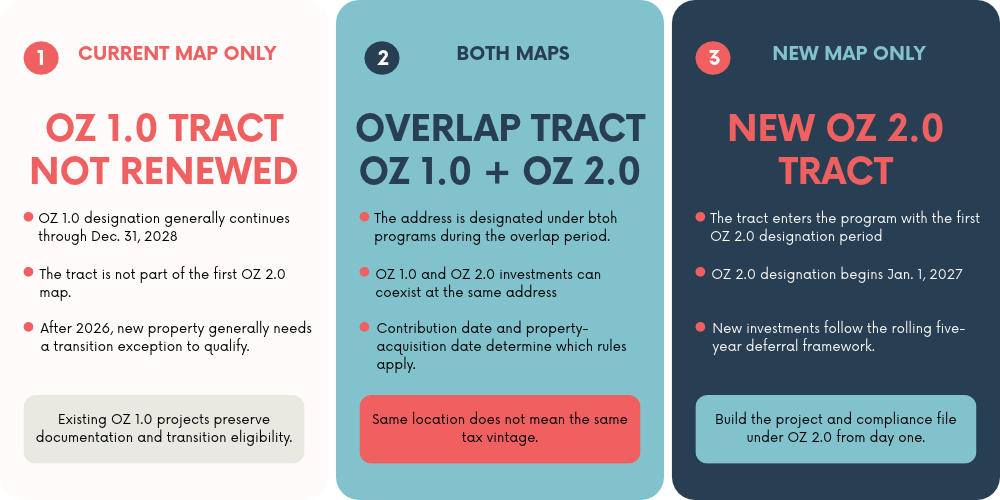
Not every Opportunity Zone will carry forward into the new program. Depending on its designation, a location may qualify under the original program, the new program or both.
This distinction matters because investments in the same geographic area may be subject to different requirements.
For example, an existing investment in an OZ 1.0 tract may continue under the original rules, while a new investment in that same location could be subject to OZ 2.0 requirements if the tract receives a new designation.
Eligibility depends on several factors, including when capital was contributed, when property was acquired and which Opportunity Zone designation applies.
Before moving forward with a new investment or expanding an existing project, confirm the applicable rules. Understanding these distinctions early can help investors and sponsors avoid costly assumptions and make more informed decisions.
For fund managers and project sponsors: Protecting projects already underway
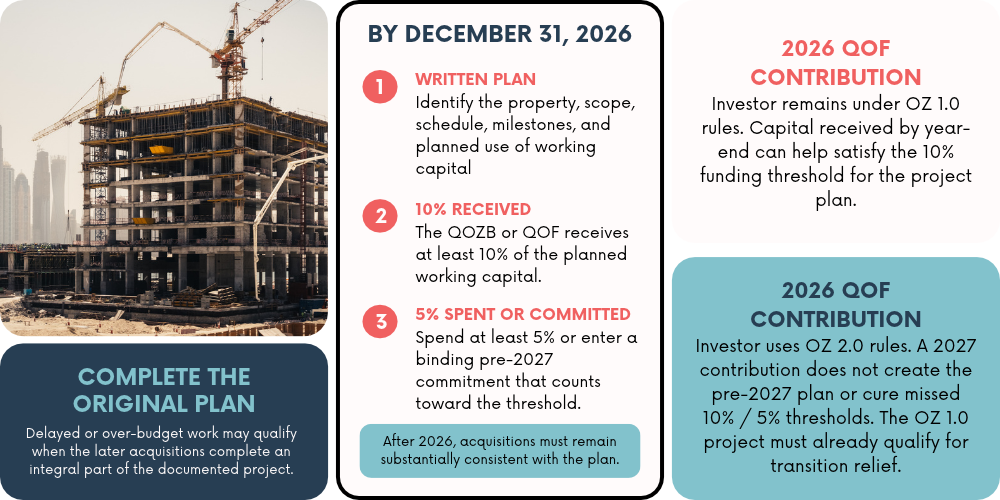
If your Opportunity Zone project won’t be completed by December 31, 2026, that doesn’t necessarily mean you’ll lose the benefits available under OZ 1.0.
However, documentation and planning will be especially important.
Under the transition framework, certain construction activities and property acquisitions occurring after 2026 may continue to qualify under the original program when they align with an eligible working-capital plan established before year-end.
That plan should clearly document the project’s scope, anticipated timeline, funding needs and key development milestones.
The transition framework also identifies two important thresholds:
- At least 10% of planned working capital must have been received.
- At least 5% must have been spent or supported by a qualifying binding commitment made before 2027.
Additional capital contributed in 2027 may help fund an eligible OZ 1.0 project. However, those contributions cannot retroactively establish a missing fund or business structure, working-capital plan or required year-end threshold.
What this means for sponsors: You don’t necessarily need to finish construction before year-end, but you do need a clear, well-supported plan for completing the project.
Reviewing project documentation, funding arrangements and outstanding commitments now can help identify potential gaps while there is still time to address them.
For fund managers and project sponsors: Preparing for expanded reporting requirements
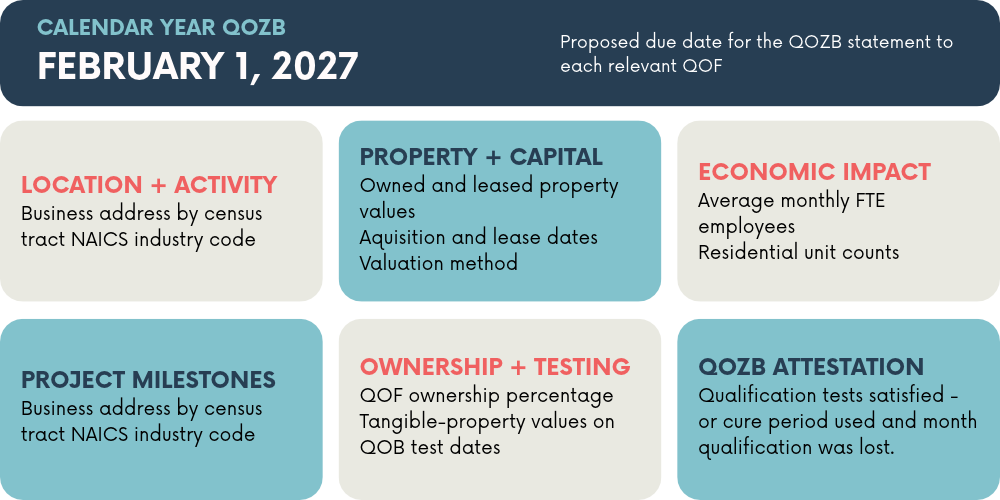
The transition also brings increased expectations around documentation and reporting.
Proposed OZ 2.0 requirements would expand the information QOZBs must provide, including details about property, employment, ownership and operations.
Depending on the final requirements, this information could include:
- Property acquisition and lease dates
- Property valuations and valuation methods
- Average monthly full-time-equivalent employment
- Residential unit counts
- Tangible-property values and ownership information
Although the proposed February 1, 2027, reporting deadline is not final, waiting for the rules to be finalized could create unnecessary challenges.
Sponsors should consider establishing a consistent process for collecting and maintaining this information now, including identifying who is responsible for gathering data and communicating it between the QOZB and QOF.
Reliable records do more than support compliance. They can also provide greater visibility into project performance and help sponsors respond confidently to future reporting or IRS review requirements.
For investors: Preparing for the 2026 tax impact
For QOF investors, one of the most immediate considerations is the recognition of previously deferred capital gains.
On December 31, 2026, deferred gains become subject to the applicable inclusion rules, potentially creating a tax liability even if the investment has not been sold or generated sufficient cash to cover the tax.
That’s why understanding the potential tax impact before year-end is so important.
The original deferral generally changed when gains were recognized, not their underlying character or other tax attributes. Investors should review both the amount and character of the gain and evaluate how recognition may affect their broader tax strategy.
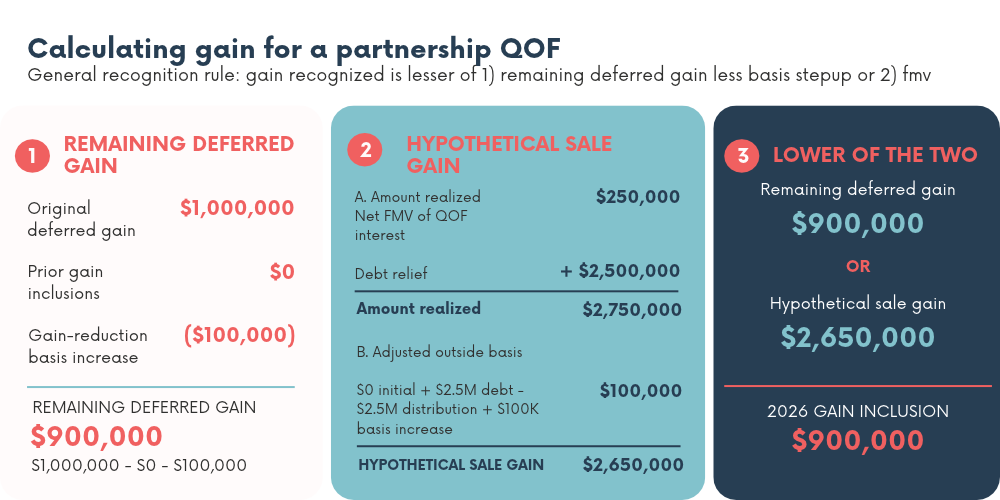
For investors in partnership QOFs, the calculation can be more complex.
Factors such as debt relief, previous distributions and adjusted outside basis may influence the taxable amount. In some circumstances, an investment with little or no remaining fair market value could still produce a significant tax consequence because of how partnership liabilities are treated.
The important takeaway: Your investment’s current value may not tell the full story of your potential tax liability.
Modeling the tax impact now gives investors more time to evaluate liquidity needs, coordinate with their advisors and make informed decisions before filing season.
Your year-end Opportunity Zone planning checklist
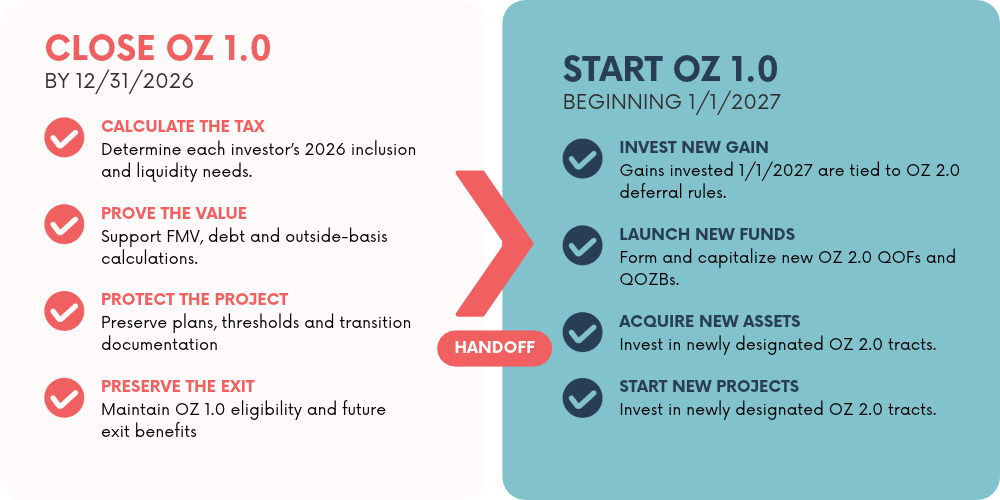
The right next steps depend on your role in the investment. Here are the priorities to address before December 31, 2026.
For QOF investors
- Estimate your tax exposure. Calculate the potential deferred-gain inclusion and determine how much cash may be needed to cover the resulting liability.
- Review your investment structure. Evaluate gain character, debt allocations, prior distributions and adjusted basis to understand the full tax implications.
- Coordinate your financial strategy. Work with your tax and wealth advisors to align tax obligations, liquidity planning and long-term investment goals.
For QOF managers and QOZB sponsors
- Review project eligibility. Confirm that working-capital plans, funding arrangements, binding commitments and project milestones meet applicable transition requirements.
- Strengthen documentation. Maintain records supporting project activity, valuations, debt allocations and investor basis calculations.
- Prepare for reporting changes. Establish processes for collecting operating data and clearly assign responsibility for reporting between QOZBs and QOFs.
Plan for the transition, not just the deadline
The end of 2026 represents an important transition for Opportunity Zone investments, but it doesn’t mark the end of the program’s potential benefits.
For investors, the priority is understanding tax exposure and preparing for its financial impact. For fund managers and project sponsors, it’s protecting existing projects while establishing the processes needed for the next investment cycle.
Taking a proactive approach now can help reduce uncertainty, preserve available benefits and position investments for the years ahead.
At Sorren, we help investors, fund managers and real estate sponsors navigate complex tax decisions with clarity and confidence. By bringing together specialized tax knowledge and real estate industry experience, our team can help you evaluate deferred-gain recognition, assess project eligibility and develop a strategy aligned with your broader financial goals.
Connect with Sorren’s tax and real estate advisors to review your Opportunity Zone strategy before year-end.
This material is for general informational purposes only and does not constitute tax, legal or investment advice. Proposed reporting requirements may change before final regulations become effective.